
- Hyatt added options to lower capital needs.
- Prototype could cut building costs by 25 percent.
- HVS says high costs constrain hotel development.
HYATT HOTELS CORP. is adding financing and design options to lower hotel capital needs. The company outlined a financing program, a smaller prototype and conversion brands.
In an Oct. 5 release, Hyatt said it averages four hotels per market, versus 14 among its largest competitors. It sees room to expand across more than 300 U.S. submarkets, making project financing key to its growth.
The timing reflects a gap between hotel performance and new supply.
“Owners are navigating a complex development landscape, and the right owner-aligned growth strategy looks different from market to market,” said Julienne Smith, Hyatt head of Americas growth. “Hyatt is in a strong position to support market growth with a broad portfolio of brands, flexible development options, the reach of the World of Hyatt loyalty platform and the support of our powerful commercial engine. That combination creates opportunities both in markets where Hyatt is underrepresented and in established markets where we can transfer continued demand.”
HVS reported U.S. RevPAR rose 4 percent through May from a year earlier. Supply grew 0.7 percent in 2025, below the 1.4 percent pre-2020 average, while lenders often require more equity. Meanwhile, Lodging Econometrics reported new project announcements rose 18 percent and construction starts 14 percent in the second quarter.
Tackling the growth gap
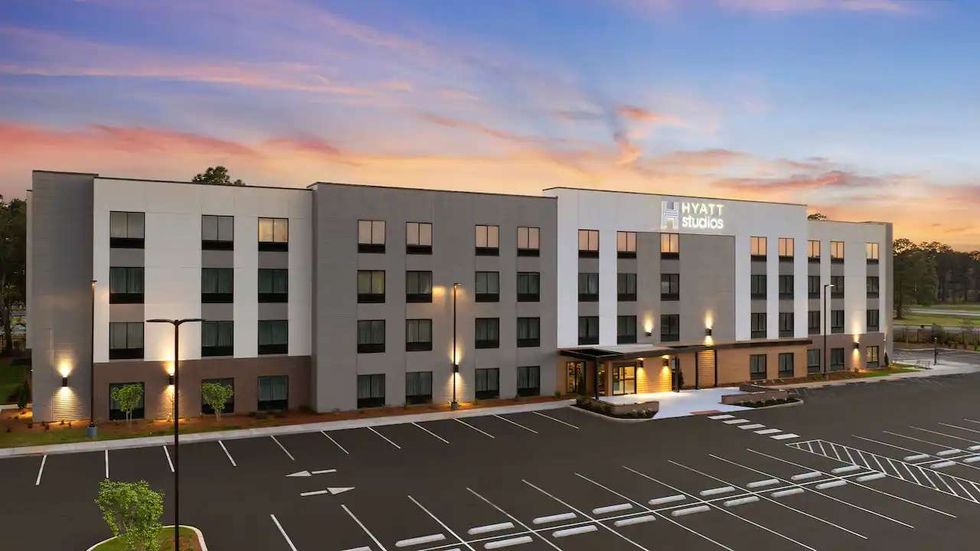 In June, Hyatt and Hall Structured Finance introduced a financing program to support the development of Hyatt Studios properties in the U.S.Photo credit: HALL Structured Finance
Hyatt and HALL Structured Finance announced a loan program for new-build Hyatt Studios projects. Hyatt said it could offer greater leverage than conventional lending, subject to underwriting and project qualifications. Hyatt Studios has more than 70 hotels and 8,200 rooms in its pipeline.
Greater leverage could reduce the equity required upfront, but the benefit will depend on the loan terms and project performance. Hyatt did not disclose loan-to-cost ratios, pricing or maturities.
The second lever is the building. Hyatt’s Gen 4 Hyatt Place prototype cuts keys from 140 to 127 and building area by nearly 20 percent. It shifts from six-story steel and concrete to four-story wood.
Hyatt projects building costs will fall by about 25 percent.
Based on those figures, the projected cost reduction exceeds the key reduction, implying lower building cost per key. But the 25 percent figure covers building costs only. Hyatt has not disclosed the impact on total development costs, including land, financing, design and other expenses.
HVS put the median U.S. hotel development cost at $213,000 per room in its 2026 survey, based on 2025 budgets, and said the figures are general guides. The 25 percent figure does not mean a 25 percent cut in total project cost.
Investment impact
 Pictured is The Georgian, The Unbound Collection by Hyatt, in Santa Monica, California, which joined Hyatt’s Unbound Collection in 2026 after operating as an independent hotel.Photo credit: Hyatt Hotels Corp.
The third lever is the existing building. Hyatt said its conversion brands let owners adapt existing assets while using its distribution network and World of Hyatt loyalty program. Hyatt Select, aimed at secondary and tertiary markets, has about 50 hotels in its pipeline.
Lodging Econometrics reported 1,567 U.S. conversion projects with 152,044 rooms at the end of the second quarter, up 15 percent and 18 percent, respectively, from a year earlier.
Hyatt describes Hyatt Studios as a lean operating model and says Gen 4 is designed to reduce operating requirements. Lower construction costs do not mean lower operating costs. For operators, the test is how the smaller buildings perform day to day.
For investors, the question is whether lower equity requirements can lift returns without adding risk. That depends on the HALL terms and project-level savings, which Hyatt has not disclosed.
Owners should test all three routes against the same project. Compare financing terms, total cost per key and projected revenue for a new build. Assess the full cost of a leaner prototype, not just building-cost savings. Compare conversion costs with ground-up development when an existing asset is available.
HVS said developers with long-term plans and access to capital can use this period for feasibility work, entitlements, design and brand selection. Those who prepare now may be positioned when capital markets ease.
The change is that Hyatt is competing for owners on three parts of the capital equation: how a project is financed, what it costs to build and whether it needs to be built.
Hyatt is adding select-service and extended-stay hotels in U.S. regional markets as supply growth remains below pre-2020 levels. Lower development costs support these formats as higher costs slow other projects, while local competition will determine performance.