
- Lodging nights rose 16.6 percent.
- Growth mainly from existing corporate accounts.
- GOPPAR forecast to rise just 1 percent.
CORPORATE HOTEL DEMAND grew in 2026 because companies recorded more nights, not because they spent more per night, according to a new report. That puts the focus on how much of that additional volume hotel owners can convert into profit in 2027.
Business expense and travel management software company Emburse recorded a 16.6 percent increase in lodging nights across its 10 highest-volume U.S. cities in H1. Average expense per recorded night fell from $292 to $289, while total lodging expense rose from $14.5 million to $16.72 million. Emburse says the per-night figure measures expense, not hotel ADR.
“The 2026 data shows why room price alone cannot give finance teams a complete view of travel spend,” said Michele Shepard, Emburse chief revenue officer. “Companies recorded more business travel lodging nights, pushing total expense higher even as expense per night went down. Going into 2027, finance and procurement teams should look at where lodging demand is concentrated, how much activity is being recorded across their workforce and whether recent travel levels are holding. That gives them a stronger basis for setting budgets and negotiating with suppliers.”
The message targets corporate buyers, but hotels are the suppliers. More room nights can lift revenue but lower spend per night can limit gains as operating costs rise.
Growth came from existing accounts
 Growth came from existing customers, not new ones, Emburse study found. Photo credit: iStock
Organizations recording lodging expenses in the 10 cities rose to 583 from 582 a year earlier, within a fixed group of 586 U.S.-headquartered customers, Emburse data showed. Employees submitting lodging expenses increased 7.5 percent, while recorded nights per employee rose 8.5 percent, from 4.4 to 4.8.
Together, these changes align with the 16.6 percent increase in lodging nights. Growth came from existing accounts, not a larger customer base. That matters because existing-account activity depends on travel policies and budgets. If companies cut trips or stays, volume can fall without losing customers.
Recorded lodging-night growth slowed from 21.4 percent in the first quarter to 11.9 percent in the second quarter, then 1.7 percent in June, 3.3 percent in July and 1.9 percent in August.
Emburse said summer figures are preliminary because late expense records can change results. The data also does not show whether employees took more trips or stayed longer and is not representative of the U.S. market.
The slowdown matters as hotel profitability is expected to grow more slowly in 2027. CoStar and Tourism Economics forecast U.S. hotel GOPPAR to rise 4 percent in 2026 but 1 percent in 2027. STR President Amanda Hite said expenses are expected to outpace inflation in both years.
That makes the Emburse trend more important. Owners must assess whether added nights generate enough rate and margin to cover higher costs.
What it means for stakeholders
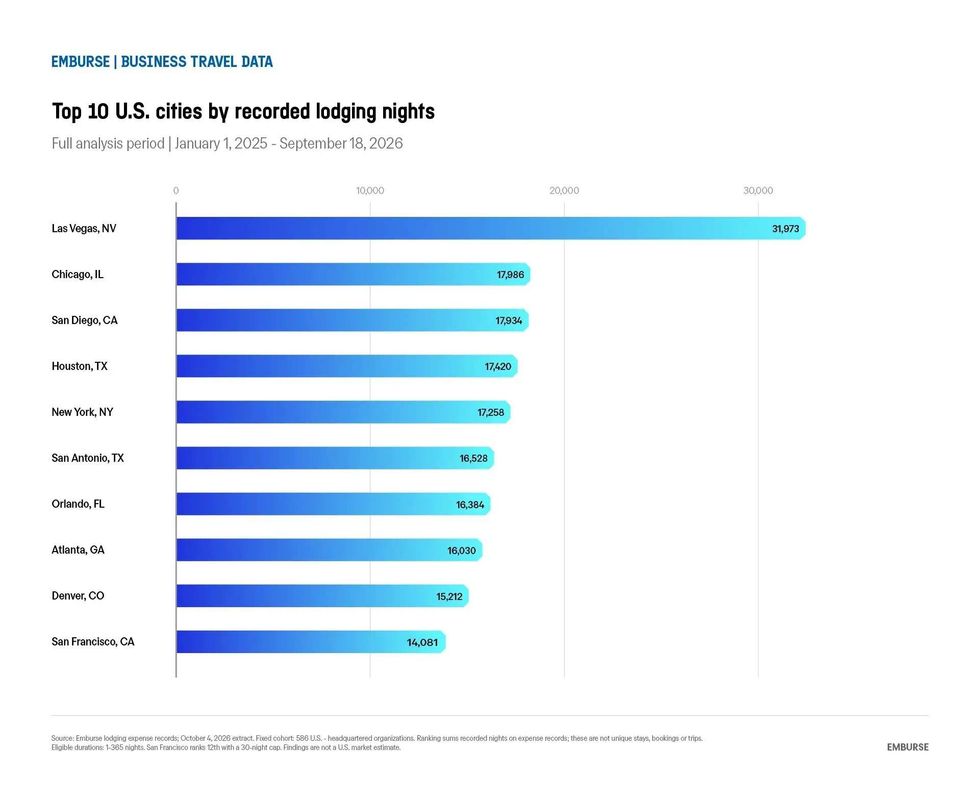 The city-level findings urge owners to look beyond top-line growth.Photo credit: Emburse
Emburse’s city data shows why owners should look beyond headline growth. Las Vegas recorded 31,973 lodging nights and 27.2 percent growth in the first half of the year. Its largest customer accounted for 7 percent of recorded nights, showing demand was spread across customers.
New York recorded 15.6 percent growth and the highest average expense, at $461.36 per night. San Francisco grew 32.3 percent, with Emburse attributing part of the increase to longer stays.
San Francisco ranked 10th with stays capped at 365 nights but 12th at 30 nights. Investors should examine growth drivers before assessing demand.
Owners should track corporate accounts by volume, stay length, rate and share of business. Operators should measure the cost of longer stays rather than assume each additional night produces the same margin.
For investors and developers, the key question is whether demand can hold as growth normalizes. CoStar expects U.S. hotel supply to grow 0.6 percent in 2027, which could support existing properties. New projects still need durable demand to justify construction and financing costs.
Emburse does not predict a contraction in corporate lodging. Its data shows first-half growth had slowed by summer, while expense per night declined. For 2027, that makes demand quality more important than headline growth. Demand is not the problem. Keeping the profit from it is.
Separately, Hyatt Hotels Corp. is adding financing and design options to lower hotel capital needs. The company outlined a financing program, smaller prototype and conversion brands.