
- Credit utilization correlates 0.75 with luxury hotel demand.
- Middle-tier hotels show strongest links to economic indicators.
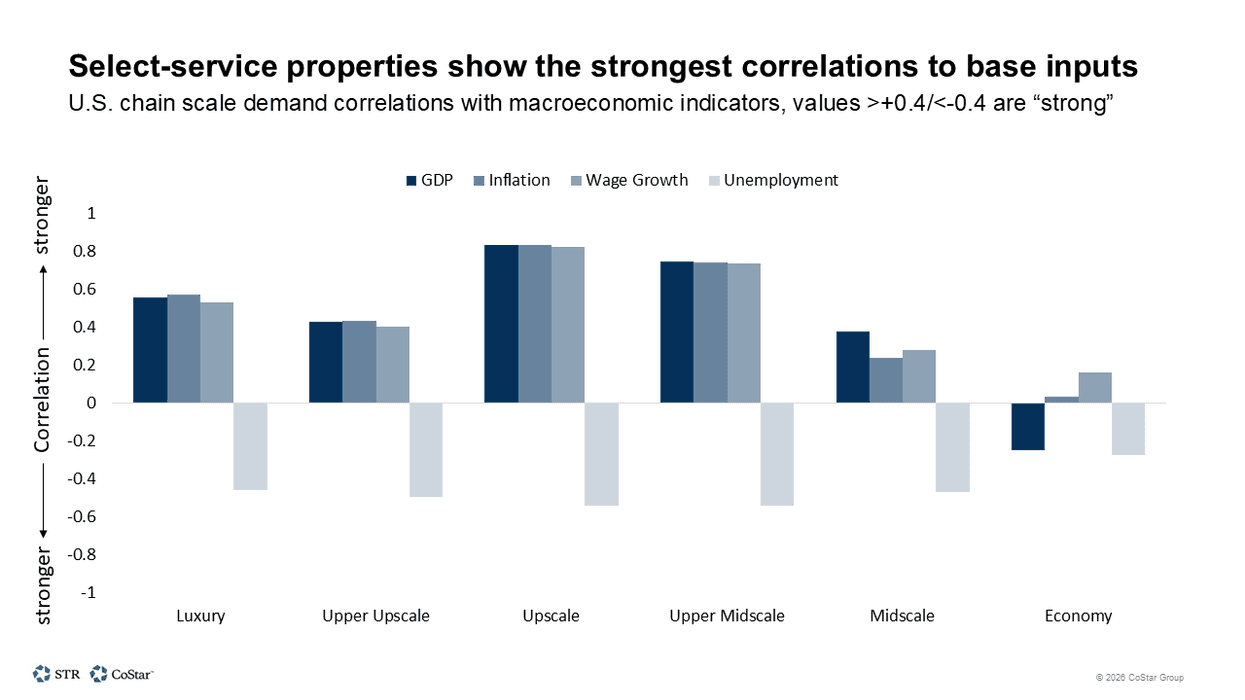
- Economy hotels show negative correlation with GDP growth.
The analysis looked at hotel demand across different segments in the U.S. and found that the link with economic factors is not the same everywhere. Mid-market hotels are most closely tied to the economy. Luxury and budget hotels are less tied and seem to depend on other factors as well.
CoStar’s STR reported that upscale and upper midscale hotel segments have a strong link with broader economic trends, with correlations of about 0.83 and 0.74. These segments mainly serve middle-income leisure travelers, small business guests and group bookings.
Luxury and upper upscale hotels showed a weaker link to overall economic measures. Luxury demand had a correlation of about 0.55 with GDP, lower than mid-market segments. High-income travelers are more influenced by their own finances than broader economic trends and group business at luxury hotels tends to stay steady even when the economy changes.
Credit utilization was found to be a stronger indicator, especially for higher-end hotels. It had a correlation of about 0.75 with luxury and upper upscale demand, higher than most traditional economic measures. The report says this is because credit utilization reflects real household spending rather than overall economic growth.
Income levels were also useful for predicting mid-market hotel demand, with correlations of 0.80 for upscale hotels and 0.71 for upper midscale. The analysis found that as household incomes rise, guests tend to choose higher-end hotels and switch to lower segments when finances tighten.
Midscale and economy hotels showed a different pattern. Their link with GDP was weak, at 0.37 for midscale and negative at -0.25 for economy. This suggests that when the economy
improves, some budget travelers move to higher hotel categories. Instead, credit and auto loan data, along with loan delinquency rates, were better indicators, showing that demand in these segments is more closely tied to personal debt levels than overall economic growth.
Another report by Phocuswright forecast stronger U.S. hotel performance in 2026, supported by higher demand, OTA growth and wider AI adoption.