
Skip to content

Search

Latest Stories

STR: Labor Day pulls U.S. hotel performance down in week of Sept. 10

Orlando reported the only occupancy increase

STR: Labor Day pulls U.S. hotel performance down in week of Sept. 10

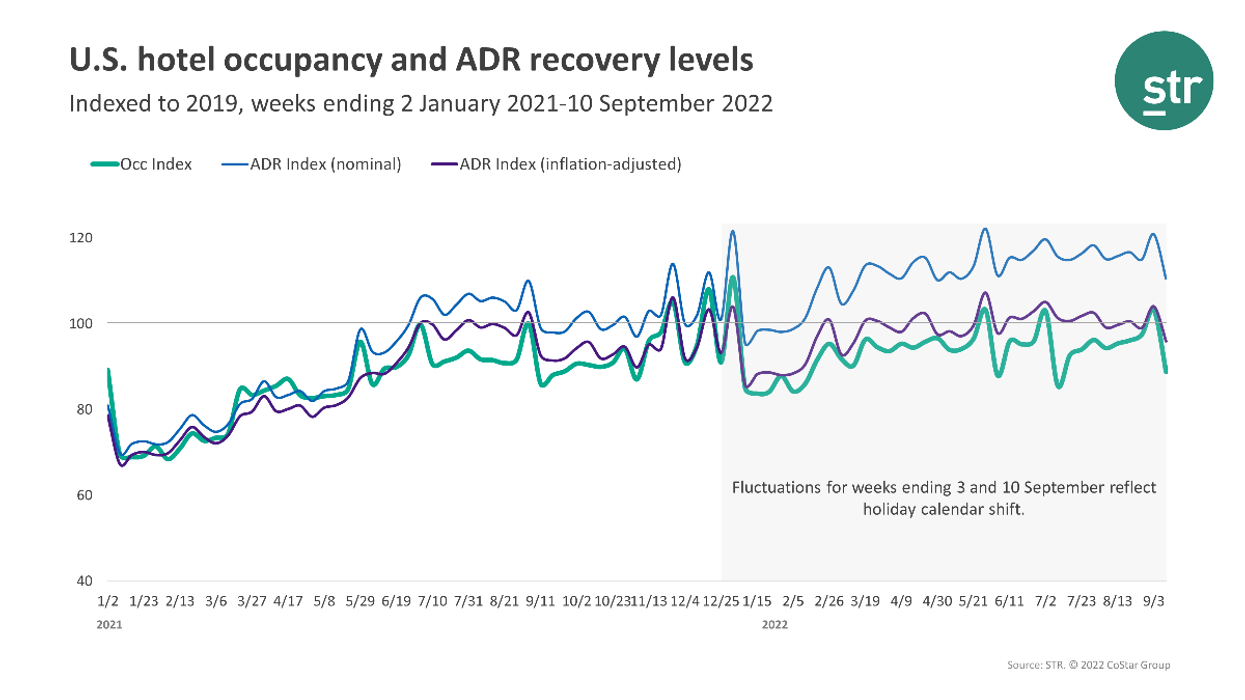
USA Labor Day : THE LABOR DAY calendar shift pulled U.S. hotel performance down in the second week of September, compared to the week before, as expected, according to STR. The weekly performance was also down when compared to 2019.

Occupancy was 61.7 percent for the week ending Sept. 10, down from 62.8 percent the week before and decreased 11.2 percent from 2019. ADR was $146.80 for the week, down from $147.14 the week before and increased 10.6 percent from three years ago. RevPAR reached $90.50 during the week, dipped from $92.45 the week before and decreased 1.8 percent from 2019.


Orlando reported the only occupancy increase, up 1.5 percent to 59.3 percent, among STR’s top 25 markets, when compared to 2019.

Miami reported the largest ADR gain, increased 34.1 percent to$175.85, over 2019.

The steepest RevPAR decline was reported in San Francisco, down 39.6 percent to $137.61, and Washington, D.C, down 39.6 percent to $84.92, over 2019.


More for you

Report: Rising Labor costs tighten US hotel industry margins
Photo credit: iStock

Report: Labor costs tighten U.S. hotel margins

Summary:

  • U.S. hotel margins tighten as demand slows and labor costs remain high, HotStats reported.
  • Unionized hotels carry 43 percent labor costs, versus 33.5 percent at non-union properties.
  • U.S. sees falling group demand and lower profit conversion since the second quarter.

THE U.S. HOTEL industry is showing signs of strain after a strong start to 2025, according to HotStats. Revenue growth is slowing, occupancy is falling and profit margins are tightening, particularly at unionized properties where labor constraints affect performance.

HotStats’ recent blog post revealed that TRevPAR has barely kept pace with labor costs in the first eight months of the year. While TRevPOR remains positive, gains are offset by declining occupancy, a sign that demand is cooling.

Keep ReadingShow less