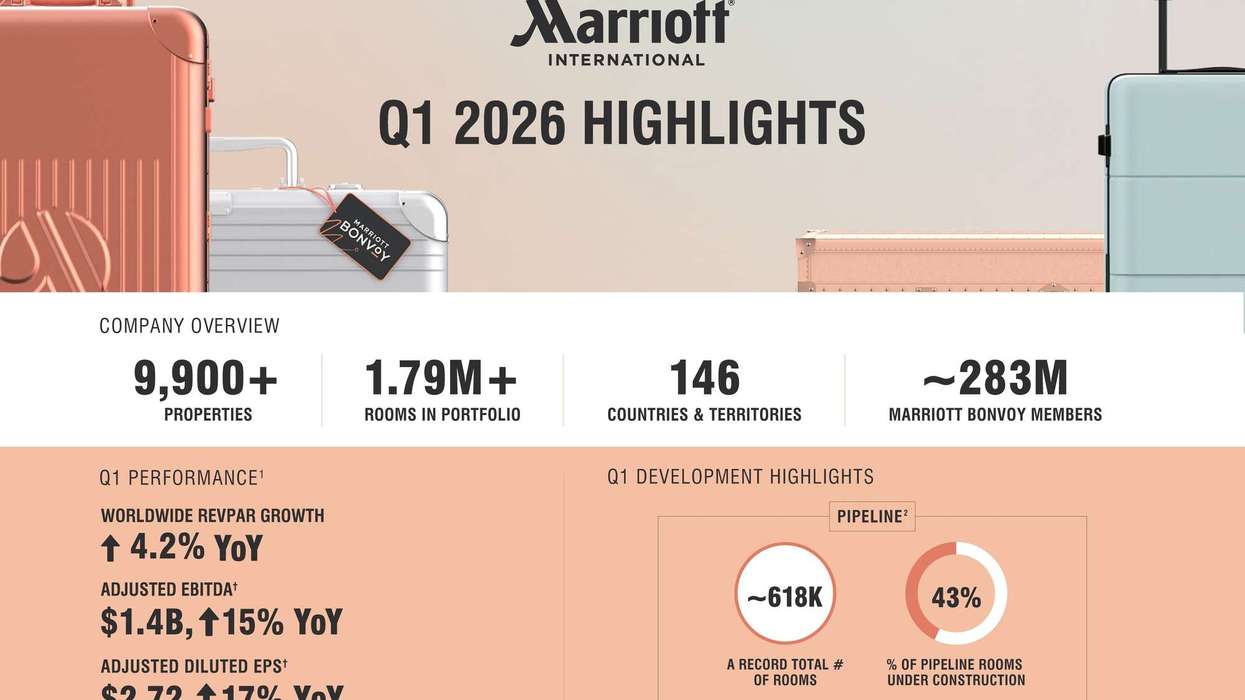

- Marriott’s worldwide RevPAR rose 4.2 percent in Q1.
- RevPAR rose 4 percent in the U.S. and Canada.
- Marriott added about 15,900 net rooms globally during the quarter.
MARRIOTT INTERNATIONAL REPORTED first-quarter results above expectations, with worldwide RevPAR increasing 4.2 percent for the quarter. The company also expanded its global development pipeline to more than 4,100 properties and nearly 618,000 rooms.
The company reported RevPAR growth of 4 percent in the U.S. and Canada and 4.6 percent in international markets, led by leisure demand in Asia Pacific and Greater China, Marriott said in a statement. Adjusted EBITDA increased 15 percent year over year to $1.398 billion, while adjusted net income rose to $726 million from $645 million a year earlier.
“We delivered excellent first-quarter results, reflecting the strength of our brands, our unmatched global footprint and the resilience of demand for travel,” said Anthony Capuano, Marriott’s president and CEO. “Global RevPAR increased over 4 percent, exceeding the high end of our expectations, driven by gains in both ADR and occupancy. RevPAR in the U.S. and Canada rose 4 percent, with performance strengthening throughout the quarter and growth broad-based across customer segments and chain scales.”
Marriott reported worldwide RevPAR growth of 1.9 percent in the fourth quarter and 2 percent for full-year 2025. Its development pipeline reached 4,100 properties and nearly 610,000 rooms.
Capuano said international RevPAR grew 4.6 percent in the first quarter despite the conflict in the Middle East affecting March results.
“RevPAR in EMEA grew more than 3 percent in the quarter, with increases in Europe and Africa partially offset by a decline in the Middle East,” he said. “APEC led international performance, with first-quarter RevPAR increasing more than 7 percent, on sustained leisure travel demand. RevPAR in Greater China increased by almost 6 percent, driven by leisure travel, particularly in Hong Kong and Hainan.”
Marriott added roughly 15,900 net rooms globally during the quarter, including about 7,500 rooms in international markets. Net rooms increased 4.5 percent from the end of the first quarter of 2025, bringing its portfolio to more than 9,900 properties and nearly 1.8 million rooms. The company’s development pipeline increased more than 5 percent year over year to nearly 618,000 rooms, with more than half located in international markets.
Marriott said 43 percent of pipeline rooms are under construction, including conversion projects. Conversions accounted for more than 35 percent of signings and more than 40 percent of openings during the quarter.
Franchise and base management fees rose 13 percent to $1.211 billion from $1.071 billion in the year-ago quarter, driven by higher co-branded credit card fees, RevPAR growth and room expansion. Incentive management fees increased to $222 million from $204 million last year, with growth in the U.S. and Canada, Asia Pacific, Greater China and the Caribbean and Latin America regions. Managed hotels in international markets contributed nearly two-thirds of incentive fees during the quarter.
Reported operating income totaled $1.064 billion, compared to $948 million in the prior-year quarter, while adjusted operating income reached $1.158 billion. Reported net income declined 3 percent year over year to $648 million due to higher interest expenses and a larger tax provision. The prior-year quarter included an $86 million tax reserve release.
During the quarter, Marriott repurchased 2.1 million shares for $700 million. Through April 29, the company returned more than $1.2 billion to shareholders through dividends and share repurchases.
Marriott projected worldwide RevPAR growth of 1.5 percent to 2.5 percent for the second quarter and 2 percent to 3 percent for full-year 2026. The outlook assumes continued travel disruption from the Middle East conflict through the rest of the year and excludes any impact from negotiations related to its U.S. co-branded credit card agreements.
In April, Marriott was again named to the Fortune and Great Place to Work 100 Best Workplaces list, extending its presence on the ranking to three decades.