
- U.S. hotel room revenue is projected to reach $214.7 billion in 2026.
- OTAs projected to outpace every other booking channel in 2026.
- Hotels account for 41 percent of U.S. travel gross bookings.
Room revenue edged up just 1 percent to $207.9 billion last year and occupancy dipped to 62.3 percent, the first time it fell since 2020, according to Phocuswright's “U.S. Hotel & Lodging Travel Market Essentials 2026.” ADR moved up just 1 percent in 2025 and rooms sold barely budged, telling a story of a market that powered through post-pandemic recovery and is now running out of easy momentum.
The forecast for 2026 shows room revenue expected to grow 3 percent to $214.7 billion, helped along by modest rate gains and a pickup in demand.
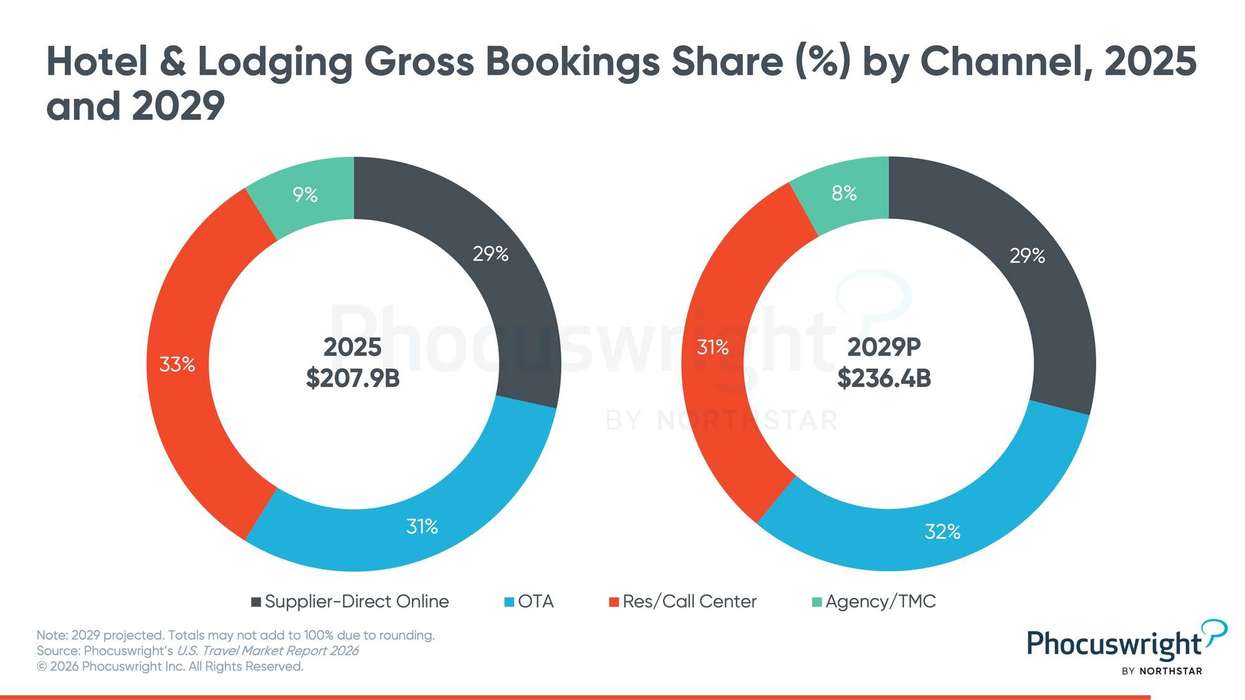
When it comes to how rooms are being booked, hotels now account for 41 percent of U.S. travel gross bookings, sitting just behind airlines at 42 percent. Online channels grew 4 percent in 2025 while offline stayed flat. Within online, the split between OTAs and hotel direct channels sits at 52 to 48 percent, a balance that is expected to hold through 2029.
OTAs are picking up speed though, driven by business-to-business offerings and serious technology investment. They are on track to outgrow every other booking channel in both 2026 and 2027.
Also, Expedia and Kayak already have booking plug-ins built into ChatGPT. Hotels are putting it to work in marketing, guest service, revenue management and day-to-day operations. Chatbots and AI-driven recommendations are growing, giving hotels with strong brands, loyal customers and unique content an advantage in travel search.
If platforms like ChatGPT, Google Gemini and Anthropic Claude push further into direct booking, the whole competitive balance between OTAs, hotel direct channels and AI-native
platforms could shift in ways that are hard to predict. The report flags this as one of the more significant open questions the industry is going to have to grapple with in the coming years.
On the other side of the ledger, luxury travel keeps doing well, corporate bookings are recovering and a calendar packed with large events should help keep rooms full. World Cup and America 250 celebrations are the two biggest demand wildcards for 2026, the report said.
International travelers have been slower to come back, partly due to stricter travel policies, geopolitical tensions, and what the report describes as anti-American sentiment in some markets. Canada, one of the most important source markets for U.S. hotels, is also contributing less than usual.
Another report by The Highland Group shows U.S. extended-stay hotels outperformed the broader hotel industry in May, driven by stronger demand growth and gains in occupancy, ADR and RevPAR.