

- 53.4 percent of business travelers manage own connectivity.
- Security is top priority for 41.7 percent.
- eSIMs complement existing cybersecurity measures.
HOTEL COMPANIES’ CYBERSECURITY planning may need to reach beyond property networks to the connections employees use while traveling. More than half of planned business travelers, 53.4 percent, manage their own internet access, according to Holafly, an eSIM provider.
The findings from Holafly for Business’s “2026 Summer Travel & eSIM Report” raise important questions for hotel owners, investors and developers about whether corporate travel policies adequately address the cybersecurity risks employees face when connecting to networks outside company control.
Security was the top connection priority for 41.7 percent of business travelers overall, according to Holafly. The share rose to 52 percent among travelers whose organizations provided their internet connection.
Employees traveling between properties, attending industry conferences or meeting business partners may need to access company systems outside their usual networks. Without a company-provided connection, they may turn to hotel or airport Wi-Fi without knowing who operates the network, the study found.
Fake access points can imitate legitimate hotel or airport networks, while fraudulent login portals can prompt users to disclose credentials or other information. These risks can arise before employees activate a corporate virtual private network or VPN.
A VPN can protect data transmitted between a device and corporate systems, but it does not establish whether the initial network is trustworthy, Holafly said. A policy banning public Wi-Fi also does not tell employees how to connect when they arrive.
Industry focus on cyber risk
 AI leads cybersecurity concerns as hospitality prioritizes risk management.Photo credit: iStock
Cyber risk is already a budget priority across the hospitality industry. The Retail & Hospitality Information Sharing and Analysis Center’s 2026 CISO Benchmark Report, developed with IANS and based on responses from 201 cybersecurity leaders across retail and hospitality, identified artificial intelligence as the leading source of friction for security teams.
About 71 percent of respondents cited AI as a primary concern, according to the report’s key findings, followed by third-party and supply-chain attacks at 54 percent and vulnerability identification and remediation at 41 percent. The findings reflect the competing demands on security teams managing emerging technology risks alongside existing threats.
The report found that 54 percent of cybersecurity leaders expected budgets to increase in 2026, up from 44 percent a year earlier, with expected increases outpacing decreases in hospitality. Budget constraints were cited as a challenge by 68 percent. The report does not quantify the financial exposure associated with business travel connectivity.
Implications for hotel businesses
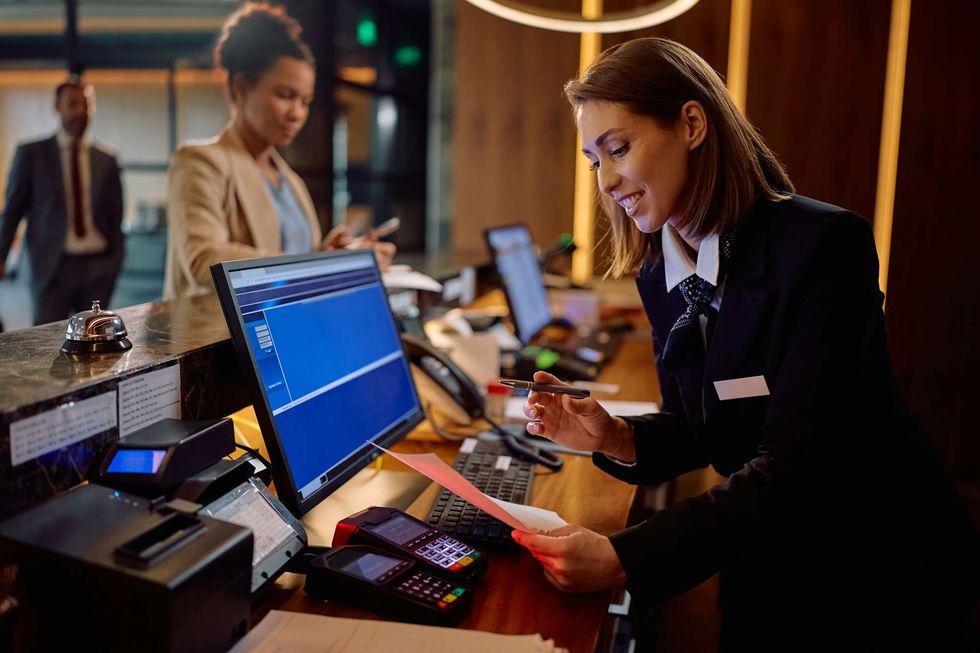 Hotels can reduce guest Wi-Fi risks through network isolation and access monitoring.Photo credit: iStock
For hotel owners and operators, cybersecurity planning can extend across employees, devices, service providers and business systems, rather than focusing only on property networks. For investors and developers, these considerations can inform technology planning, operating budgets and business continuity assessments.
One option is to provide employees with company-managed mobile connectivity, such as international eSIMs, before departure, Holafly said. An eSIM can reduce reliance on public Wi-Fi, but it does not eliminate cyber risk or replace VPNs, multifactor authentication, device updates, access controls and incident-response procedures.
Hotel owners also have a role in protecting the networks they provide to guests. Displaying the official Wi-Fi network name at check-in, isolating guest devices from one another and monitoring for unauthorized access points can help reduce the risk of lookalike networks.
In summer 2024, 82 percent of North American hotels experienced a cyberattack, according to a VikingCloud study reported by Asian Hospitality. Guest Wi-Fi network compromise or misuse was among the leading attack methods, at 38 percent.
For hotel businesses with limited technology resources, the question is not only whether to prohibit public Wi-Fi. It is whether employees have a practical alternative and whether connectivity policies align with the company’s broader security requirements.
As hospitality companies review cybersecurity spending and business continuity, travel connectivity is one area to consider. Providing employees with an approved way to get online can help close the gap between security policies and day-to-day business needs without treating any single technology as a complete solution.