
- U.S. enforcement targets birth-tourism networks.
- Order leaves “certain family members” undefined.
- Research shows multiple motivations for childbirth travel.
THE U.S. SPENT seven weeks tightening enforcement against birth tourism, moving from an executive order to a task force and new visa restrictions. For families hosting relatives, the key question is how the latest policy's undefined reference to “certain family members” will be applied.
President Donald Trump signed Executive Order 14419, “Ending Birth Tourism,” on Aug. 6, directing the State Department and Department of Homeland Security to prevent entry, revoke visas and take action against people or entities facilitating birth tourism. The order defines birth tourism as entering the U.S. on a nonimmigrant visa for the purpose of giving birth, or facilitating such entry.
Six days later, the State Department established a Birth Tourism Prevention Task Force. The department said the task force would review visa holders' activities worldwide, connect information held across federal agencies and identify cases involving birth tourism. It reported that the task force had revoked more than 600 visas.
An undefined provision
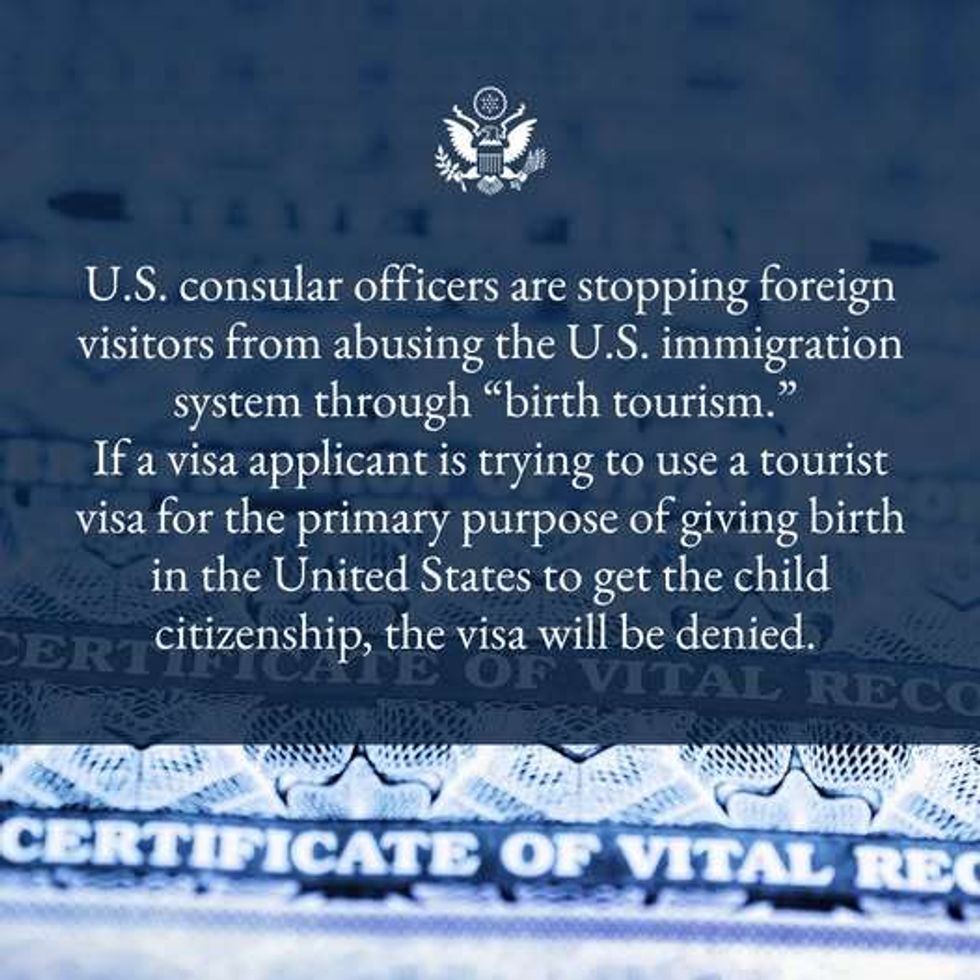 Photo credit: U.S. Department of State/Facebook
On September 23, Secretary of State Marco Rubio announced a new visa restriction policy under Section 212(a)(3)(C) of the Immigration and Nationality Act. The policy targets owners, operators and managers of commercial birth-tourism networks, visa “fixers” who coach applicants to commit fraud, foreign medical providers who knowingly facilitate such travel and fraudulent Medicaid use, and others who support or enable commercial birth tourism.
The State Department also said certain family members of people covered by the policy may be subject to the restrictions. That last provision is where the policy becomes less clear. The announcement does not identify which relatives are covered, how close the family relationship must be or what conduct would bring a family member within the restriction.
Immigration law firm Murthy Law Firm said the announcement provides no detailed standards or procedures for identifying covered individuals or family members.
The uncertainty does not mean relatives who host or assist visitors are automatically subject to the restrictions. The published policy does not say that paying for a parent's ticket, providing accommodation or helping a relative arrange a legitimate visit constitutes participation in commercial birth tourism.
What remains unclear is where officials would draw the line between a family member involved in a prohibited commercial scheme and a relative providing ordinary support.
The scale remains disputed
 Photo credit: iStock
The enforcement push is also unfolding against uncertainty over the size of the practice being targeted.
The Migration Policy Institute said in April that there is no official U.S. estimate of birth tourism. It cited the most expansive estimate at 22,000 to 26,000 births a year, while noting that the estimate is contested. CDC data showed nearly 9,600 U.S. births in 2024 to mothers whose listed addresses were outside the U.S. or its territories, but MPI said that figure is only a proxy because it includes women who did not necessarily travel to the U.S. intending to give birth.
Recent research suggests childbirth travel can involve different motivations. A 2025 qualitative study of 25 Nigerian women who gave birth in the U.S. or Canada found that participants' experiences included seeking birthright citizenship and access to healthcare. The researchers said their findings underscore the need for greater clarity on the legality of traveling abroad for childbirth and birthright citizenship.
The Trump administration recently proposed ending the 60-day grace period that allows H-1B workers to remain in the U.S. after losing their jobs while seeking a new sponsor. The move could affect Indian technology professionals, who account for a large share of H-1B holders.