
U.S. Hotel Industry Reports Record-High ADR and RevPAR
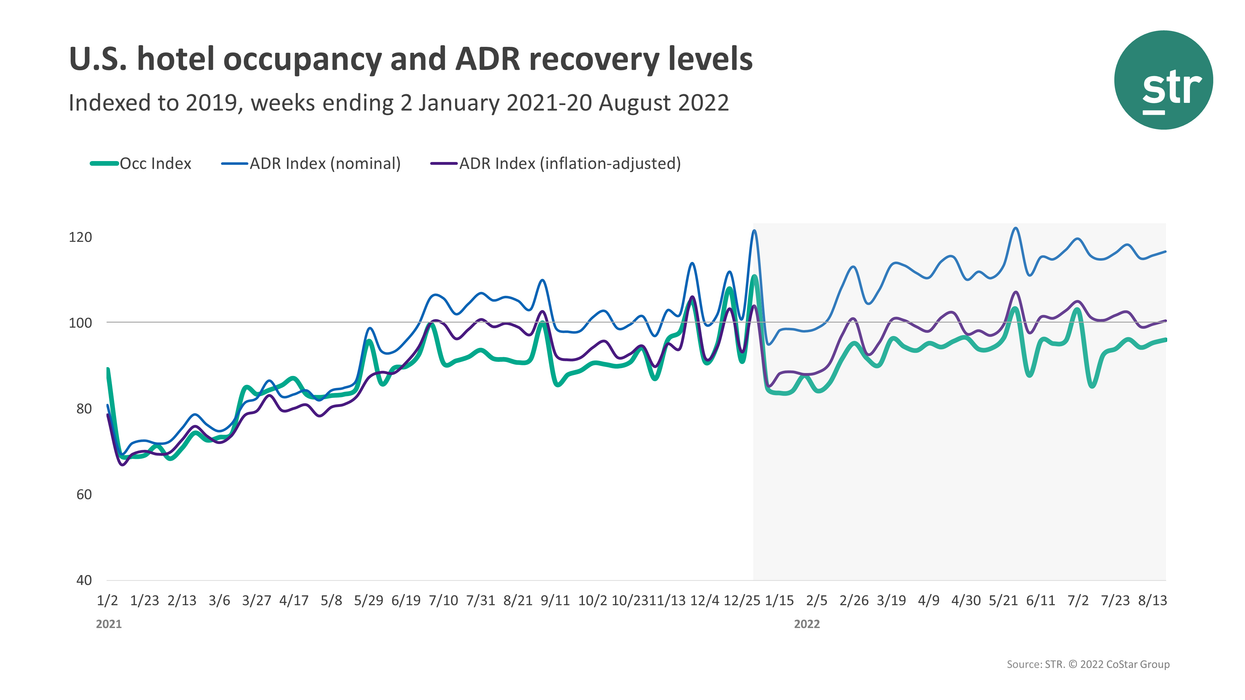
U.S. HOTELS REPORTED record-high monthly room rates on a nominal basis in July, according to STR. RevPAR on a nominal basis hit an all-time high during the month and occupancy was the second highest since August 2019. However, performance dipped some in the third week of August on a weekly basis, but performance improved during the week over 2019.
Occupancy was 69.6 percent in July, down from 70.1 percent in June and down 5.4 percent from three years ago. ADR was $159.08 during the month, up from 155.04 in June and up 17.5 percent over 2019. RevPAR reached $110.73 in July, up from $108.64 the month before and increased 11.2 percent three years ago.
At the same time, occupancy dropped to 67.3 percent for the week ending August 20, down from 68.5 percent the week before and dropped 3.9 percent from 2019. ADR was $150.96 for the week, decreased from $152.34 the week before and increased 16.7 percent from three years ago. RevPAR reached $101.59 during the week, fell from $104.30 the week before and increased 12.2 percent from 2019.
Among STR’s top 25 markets, Oahu Island experienced the highest occupancy level during July at 86.3 percent, down 2.1 percent, over 2019. These markets showed higher occupancy and ADR than all other markets due to improvements in business and group travel.
New Orleans reported the lowest occupancy in July (57.2 percent) followed by Phoenix (57.3 percent). San Francisco reported the steepest decline in occupancy, down 16.2 percent, over 2019.
During the week of Aug. 20, none of STR’s top 25 markets showed an occupancy increase during the week over 2019. Detroit came closest to its pre-pandemic comparable, dipped 2.5 percent to 68 percent.
Miami posted the largest ADR gain, up 33.4 percent to $189.57, over 2019. The steepest RevPAR deficit was in San Francisco, down 28.8 percent to $150.51.