
- Highland Group: Extended stay outperforming comparable classes.
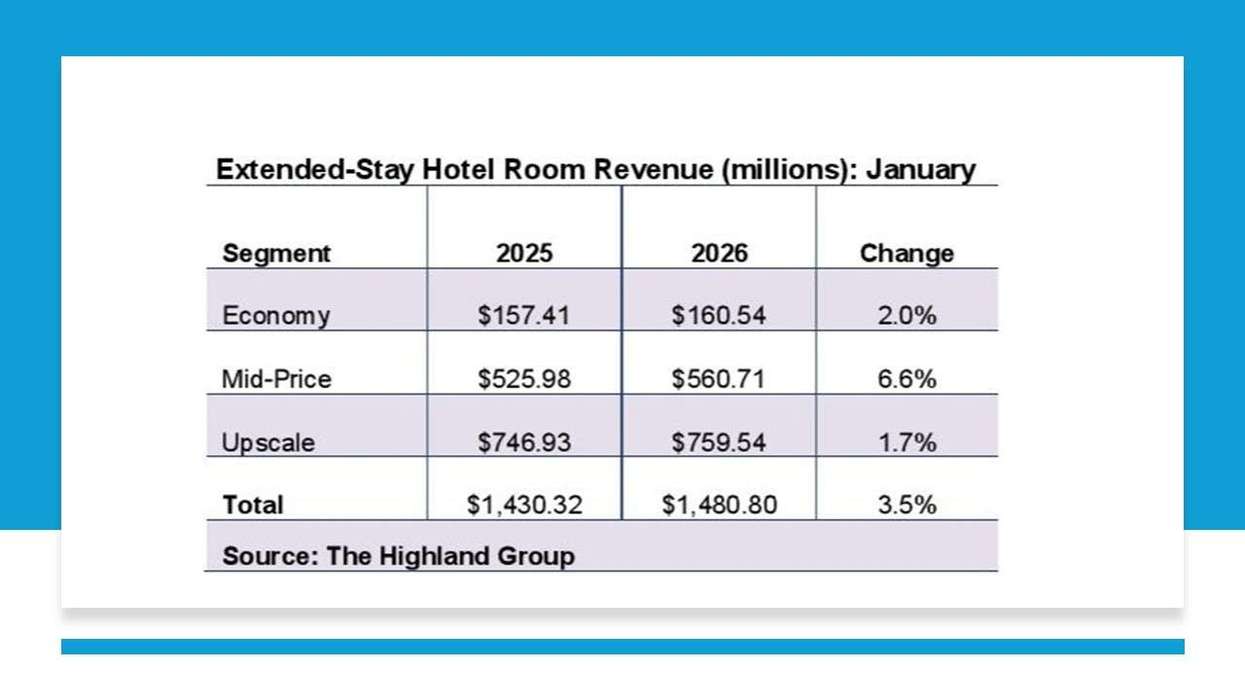
- January revenue rose 3.5 percent, the largest gain since December 2024.
- Extended-stay occupancy fell 0.3 percent in January from a year earlier.
EXTENDED-STAY HOTELS BEGAN 2026 on a strong footing, with most performance metrics outperforming comparable hotel classes, according to The Highland Group. January data showed gains in demand and room revenue as supply growth slowed and the sector’s RevPAR decline eased.
The “US Extended-Stay Hotels Bulletin: January 2026” reported the segment outperformed the broader hospitality market, signaling stabilization after months of decline. Demand and revenue posted their largest monthly gains in more than a year, while the drop in RevPAR was the smallest since April 2025.
“With the overall hotel industry showing signs of emerging from the downturn, January’s relatively strong extended-stay hotel performance is a good early indicator for 2026,” said Mark Skinner, partner at the firm.
Extended-stay supply growth slowed at the start of the year as new rooms entered the market. Room revenue and demand gains outpaced the broader hotel sector.
Demand and revenue growth
Extended-stay hotel room revenue increased 3.5 percent in January from a year earlier, the largest gain since December 2024, The Highland Group said. Data from STR and CoStar Group showed overall hotel room revenue rose 0.5 percent in the same period.
Excluding luxury and upper-upscale properties, which include little extended-stay supply, hotel revenue fell 0.2 percent. Economy hotels declined 6.3 percent, midscale hotels increased 1.3 percent and upscale properties rose 0.6 percent year over year.
Demand at extended-stay hotels increased 4.4 percent in January, the largest gain since November 2024 and above the 0.4 percent growth reported for comparable hotel classes. Adjusting for the extra day in February 2024, extended-stay demand has increased in 37 of the past 38 months.
Occupancy, ADR and RevPar
Extended-stay hotel occupancy fell 0.3 percent in January from a year earlier, the thirteenth consecutive monthly decline and less than the 0.7 percent drop across comparable hotel classes, the report said. Occupancy remained about 15 percentage points above the average for comparable hotel segments, while economy extended-stay hotels recorded their first increase since December 2024.
ADR declined for the tenth straight month, with variation by segment. Economy extended-stay hotels posted the largest ADR decline but less than the 4.1 percent decrease across all economy hotels. Mid-price extended-stay hotels recorded an ADR increase while comparable midscale hotels declined 0.3 percent and upscale extended-stay ADR fell 0.3 percent compared with a 0.1 percent gain among upscale hotels.
RevPAR for extended-stay hotels fell 1.1 percent in January, the tenth consecutive monthly decline and the smallest since April 2025. RevPAR fell 6.1 percent in economy hotels, 0.3 percent in midscale hotels and 1.3 percent in upscale hotels. Excluding luxury and upper-upscale categories, overall hotel RevPAR declined 1.4 percent.
The Highland Group recently reported that extended-stay performance declined in 2025 as supply increased across the 100 largest U.S. metropolitan areas. National RevPAR fell 2.2 percent from 2024, driven by lower occupancy.