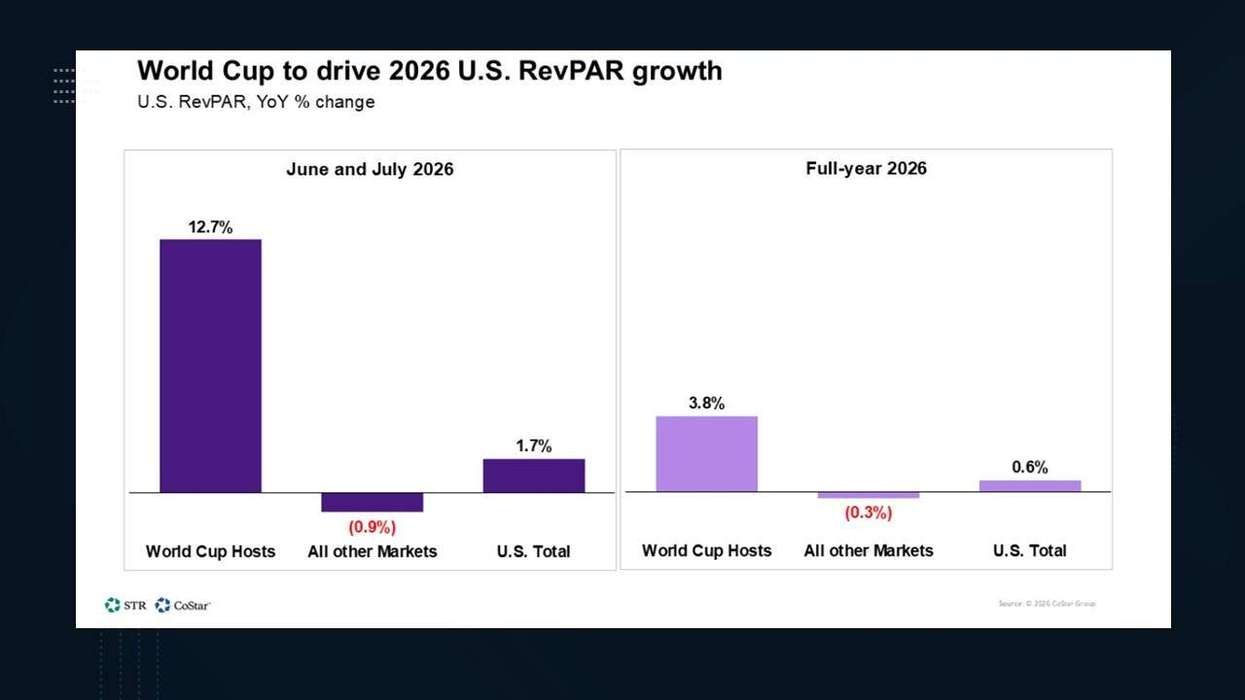

- CoStar and TE: RevPAR may rise 1.7 percent during the World Cup.
- Host markets are expected to gain 3.8 percent RevPAR for the year.
- World Cup growth is expected from a 1.6 percent ADR increase.
U.S. REVPAR IS expected to rise 1.7 percent during the World Cup months of June and July, according to the latest U.S. hotel forecast from CoStar and Tourism Economics. The increase would contribute to this year’s overall industry growth.
All but one of the 11 U.S. World Cup host cities are in STR’s top 25 markets, highlighting the event’s concentration in the country’s largest hotel markets, the report said.
“Our forecast is tempered by the uncertainty surrounding international inbound travel, which fell in 2025 due to policy and perception changes,” said Isaac Collazo, STR’s senior director of analytics. “Still, a 1.7 percent increase would be better than the month before, which fell 0.4 percent and the month after, which rose 1 percent, around the World Cup.”
For 2026, the industry is forecast to see a 0.6 percent RevPAR increase after a 0.3 percent decline in 2025. Without the World Cup gain, growth would be 0.2 percent, 40 basis points lower.
During the 1994 U.S. World Cup, June and July RevPAR rose 6.9 percent, driven by a 5 percent increase in average daily rate. This year’s World Cup growth is expected to come almost entirely from a 1.6 percent ADR increase.
Host markets are expected to see a 3.8 percent RevPAR gain for the year and 12.7 percent in June and July. In 1994, host cities saw June/July RevPAR rise 11.9 percent. Without the World Cup, 2026 host markets would be forecast for 2 percent RevPAR growth.
Collazo said that while host markets may gain, the impact on the U.S. average is negligible due to expected weakness elsewhere.
Forward-booking data shows occupancy rising from the first U.S. match on June 12 through July 4. After the holiday, occupancy returns to the pace seen before the tournament.
A recent JLL report showed that resorts and trophy assets are key investment targets in the U.S., as the 2026 FIFA World Cup and America’s 250th anniversary are expected to boost lodging demand in major cities.