
U.S. HOTEL PERFORMANCE experienced a decline in the last week of June from the previous week, according to STR. However, year-over-year comparisons showed signs of improvement.
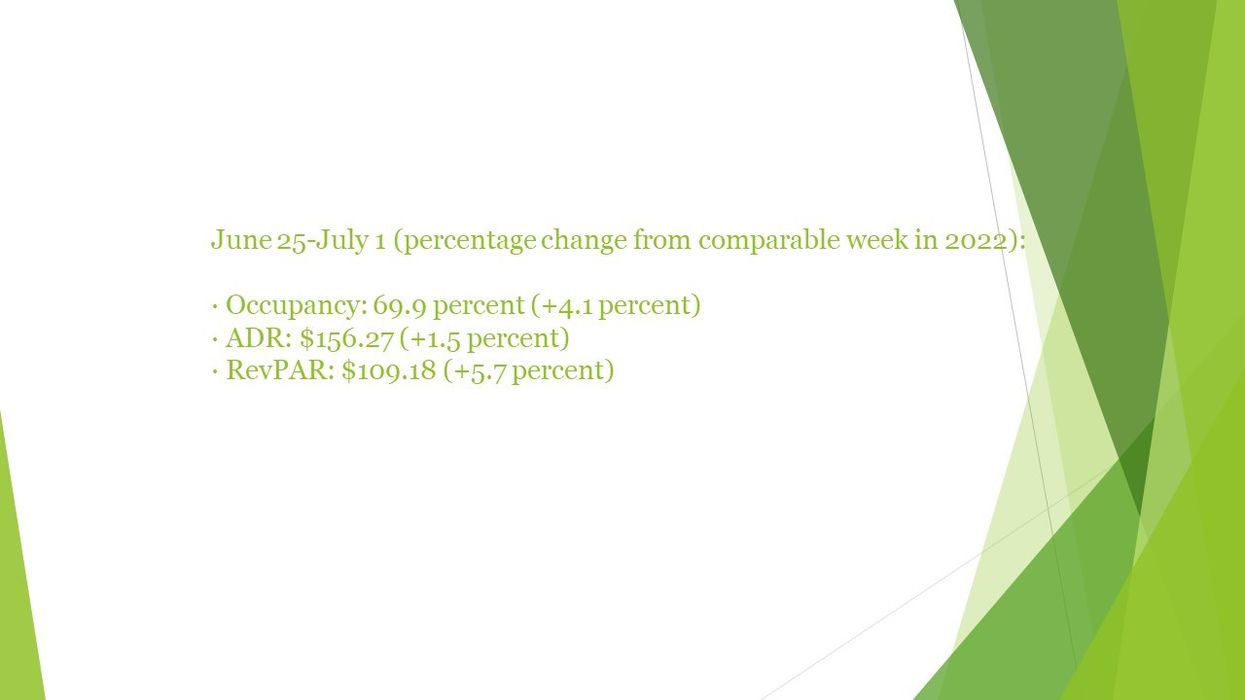
Occupancy dropped to 69.9 percent in the week ending July 1, declining from the previous week's 71.4 percent and experiencing a 4.1 percent decrease compared to 2022. ADR stood at $156.27, slightly lower than the previous week's $159, but still reflecting a 1.5 percent increase compared to the same period last year. RevPAR was $109.18, down from the previous week's $113.58, yet indicating a 5.7 percent increase compared to 2022.
Among the top 25 markets, St. Louis experienced the most significant year-over-year increases in occupancy, rising by 22.2 percent to reach 71.6 percent. Additionally, RevPAR saw growth of 39.3 percent, reaching $96.46.
Philadelphia achieved the largest increase in ADR, with a notable rise of 16.4 percent to reach $170.53.
The steepest RevPAR declines were observed in New Orleans, which decreased by 25.1 percent to $119.12, and Miami, which experienced a decline of 10.2 percent to $112.20.