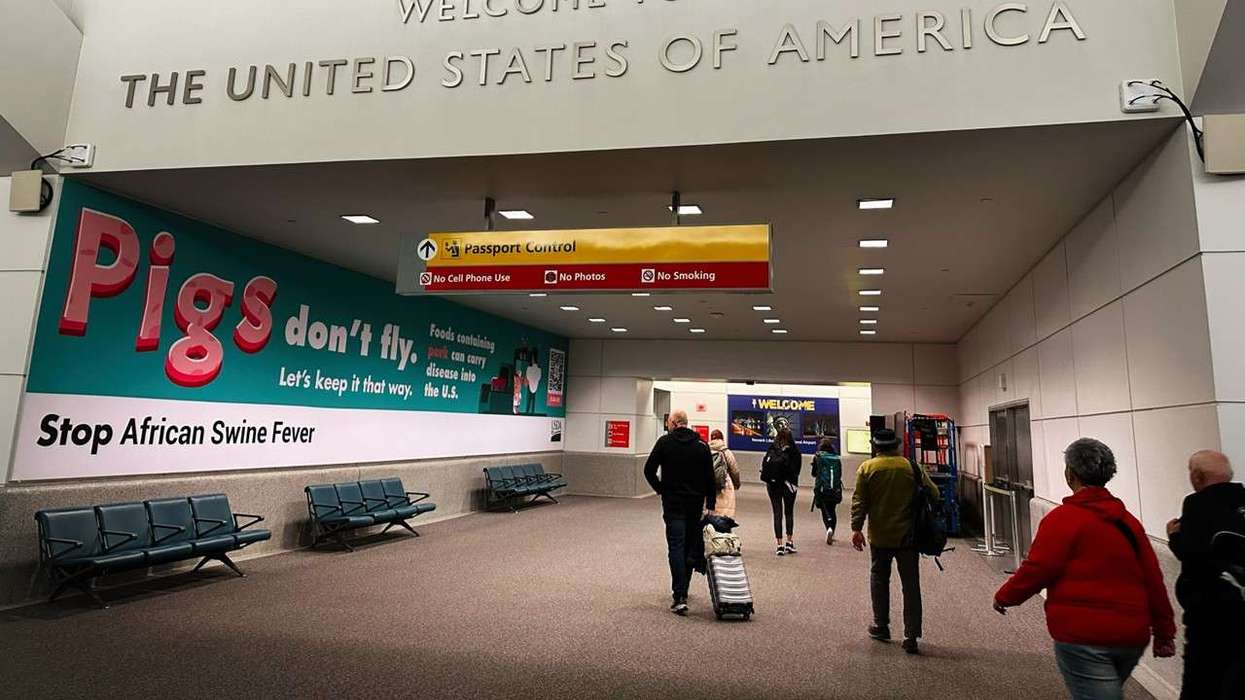

- Overseas arrivals fell 7.2 percent in October.
- Year-to-date overseas visitation is down 5.8 percent.
- CoStar, TE forecast 2.7 percent RevPAR growth in 2027.
OVERSEAS VISITOR ARRIVALS to the U.S. fell 7.2 percent year over year to 2.8 million in October, according to the National Travel and Tourism Office. The decline came as total U.S.-international air traffic stayed nearly flat, showing a shift in the mix of international travelers that overall passenger counts do not reveal.
Overseas visitation was down 5.8 percent year to date through October, according to NTTO's I-94 arrivals data. U.S.-international air passenger enplanements fell 0.3 percent to 21.3 million, NTTO's international air travel statistics showed. Non-U.S. citizen air arrivals declined 2.5 percent to 4.6 million, while U.S. citizen departures fell 0.2 percent to 5.7 million.
The gap reflects how the two datasets count travelers. The air traffic figures include U.S. citizens, permanent residents, crew and transit passengers. The overseas count covers only visitors staying at least one night on visitor visas and excludes Canada and Mexico, making it the closer measure of international hotel guests.
Gateway markets carry the exposure
 Mexico and Canada lead U.S. air traffic, while UK, Germany, Japan and Middle East arrivals decline.Photo credit: iStock
Mexico led country traffic with 2.9 million air passengers, up 0.1 percent, followed by Canada with 2.5 million, up 1.9 percent. The UK fell 1.8 percent to 1.9 million, Germany 5.2 percent to 983,000 and Japan 4.7 percent to 934,000.
By region, Europe rose 0.4 percent to 7.1 million passengers and Asia rose 1 percent to 2.7 million. South and Central America and the Caribbean fell 1.4 percent to 4.4 million, while the Middle East fell 7.2 percent to 1.1 million. NTTO records passengers by their last foreign airport, so travelers from India and other markets who connect through Gulf or European hubs are counted under those regions.
New York's John F. Kennedy International Airport led U.S. gateways with 2.7 million international passengers, followed by Los Angeles with 1.9 million, Miami with 1.8 million, Newark with 1.4 million and Chicago O'Hare with 1.3 million. London Heathrow led foreign airports with 1.6 million, followed by Toronto with 1 million, Paris Charles de Gaulle with 769,000, Mexico City with 761,000 and Frankfurt with 641,000. Hotels in these gateway markets, where long-haul visitors are concentrated, are most exposed to the overseas decline.
Domestic demand fills the gap
 Domestic and group travel sustain U.S. hotel demand, with RevPAR forecast to grow 2.7 percent in 2027.Photo credit: iStock
The overseas decline has not slowed overall hotel performance. In their Q4 2026 U.S. hotel forecast assumptions, released Nov. 20, CoStar and Tourism Economics said the industry recorded its best September in 20 years and October approached its historical high, with weekday business and group demand holding through holiday periods.
The forecast projects 2027 RevPAR growth of 2.7 percent, based on 1.3 percent demand growth and 1.8 percent ADR growth. Group demand is recovering mainly in luxury and upper-upscale hotels, while companies holding travel budgets in check may shift business travelers toward select-service properties. The typical booking window has shortened from about 60 days to 30 to 40 days, affecting revenue management, staffing and purchasing.
For owners, the data show that domestic, corporate and group travel, not international guests, are driving hotel growth. Gateway properties that rely on long-haul visitors should track guest origin and booking pace separately, since market-wide gains can mask a shrinking overseas segment. Investors and developers underwriting gateway assets should test projections against continued overseas weakness rather than this year's results.
Overseas air arrivals fell 8 percent year over year in the second quarter, even with the World Cup underway, according to the National Travel and Tourism Office. NTTO's November and December data will show whether the decline continues through the holiday season.