
- Extended-stay performance fell in 2025 as supply rose, The Highland Group said.
- National RevPAR dropped 2.2 percent from 2024 due to lower occupancy.
- About 69 MSAs reported lower RevPAR, with 22 falling more than 5 percent.
EXTENDED-STAY PERFORMANCE DECLINED in 2025 as supply increased across the 100 largest U.S. metropolitan areas, according to The Highland Group. National RevPAR fell 2.2 percent from 2024, driven primarily by lower occupancy.
The Highland Group’s supplement to “The US Extended-Stay Hotel Market 2026”, titled “US Extended-Stay Hotels: 100 Largest Markets 2026”, analyzed supply, demand, revenue and construction trends in the 100 largest MSAs. 45 MSAs recorded RevPAR declines above the national average in 2025, while about one-third posted gains; only nine, mostly smaller MSAs, saw increases above inflation.
“With about one-third of MSAs expecting 5 percent or less extended-stay supply growth and no increase forecasted in one-quarter of the 100 largest markets in 2026, the near-term outlook is generally good for extended-stay hotels,” said Mark Skinner, partner at The Highland Group.
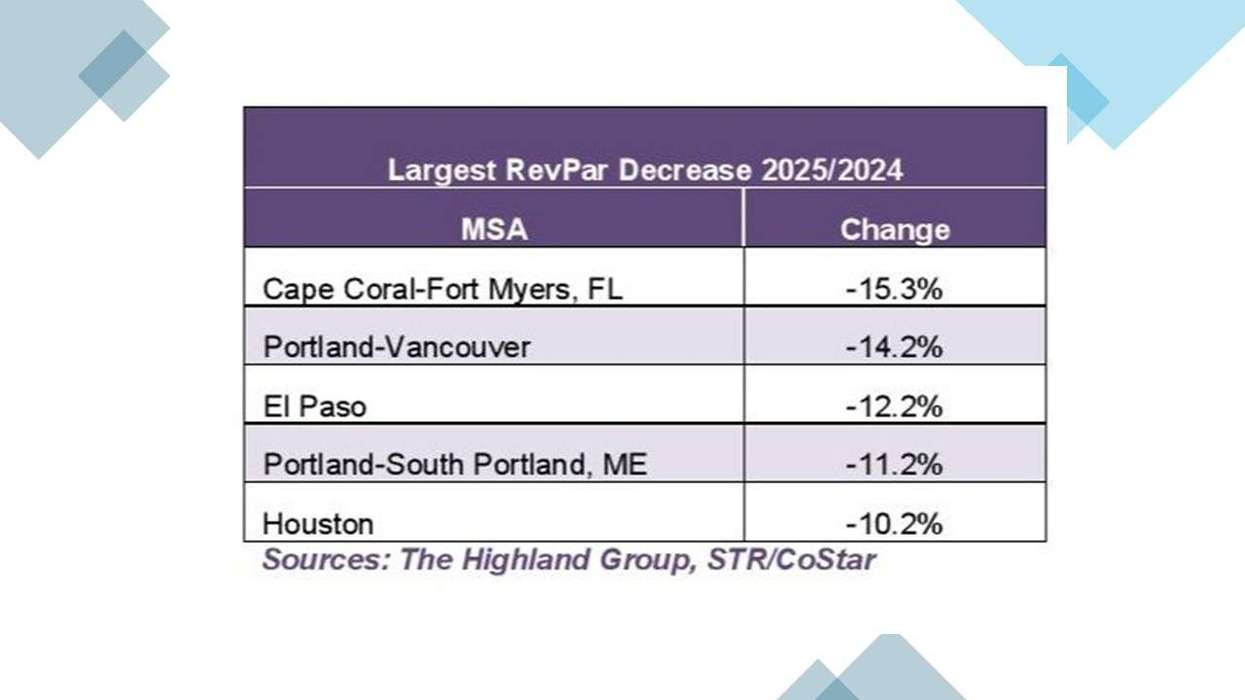
Around 69 MSAs reported lower RevPAR year over year, with declines exceeding 5 percent in 22 markets, the report found. For the second year, the decrease in Cape Coral-Fort Myers was attributed to ADR normalization following hurricane-related rate increases.
Supply rose despite weaker revenue
Extended-stay room supply in the 100 largest MSAs rose 4.9 percent in 2025, more than double the prior year’s pace. An estimated 23,268 rooms were added, a 5.1 percent increase.
At the end of 2024, more than 30,000 rooms were under construction, but net room growth by the end of 2025 was below 24,000, The Highland Group said. The difference reflects development timelines, brand exits, conversions to apartments and municipal acquisitions for housing.
The pipeline declined, with 24,817 rooms under construction at the end of 2025, down 21 percent from a year earlier. If all open in 2026 and no rooms close, supply would rise 5.2 percent, though growth is expected to be lower. The near-term risk of oversupply across the 100 largest MSAs is low.
More than three-quarters of extended-stay rooms are in the 100 largest MSAs. Extended-stay accounts for more than 15 percent of total hotel supply in 47 MSAs and 20 percent or more in seven markets. Boise City, Oklahoma; Oxnard-Thousand Oaks, California; and Raleigh, North Carolina, have the largest shares, while Myrtle Beach, South Carolina; Rochester, New York; and Santa Rosa, California, have the smallest.
Future supply outlook
In 2026, 25 MSAs are forecast to record extended-stay supply growth of 10 percent or more, mainly in smaller markets. Phoenix is the only top 25 hotel market expected to exceed 10 percent growth, assuming all rooms under construction open before year-end.
Over the past five years, extended-stay occupancy averaged 78 percent or more in one-fifth of MSAs, while 10 MSAs averaged below 70 percent, led by Des Moines at 65.9 percent. Comparable class hotels nationally averaged 61.2 percent over the same period, excluding luxury and upper upscale segments.
ADR rose 23.4 percent nationally from 2021 to 2025, with over one-fifth of MSAs reporting gains of 30 percent or more and four markets exceeding 50 percent. ADR increased in all but one MSA, with Santa Rosa recording a decline. RevPAR rose 23 percent nationally, with 30 MSAs gaining at least 30 percent and 11 more than doubling the national rate, often in larger markets that lagged early post-pandemic recovery.
The Highland Group recently reported that extended-stay hotels showed signs of stabilizing in December, with RevPAR falling 2.1 percent—the smallest monthly decline since April—and occupancy 14.6 percentage points above the overall hotel industry.