
Skip to content

Search

Latest Stories

STR: U.S. hotel performance declines in Memorial Day holiday week

Las Vegas registers the highest occupancy lift, climbs 9.5 percent to 73.5 percent

STR: U.S. hotel performance declines in Memorial Day holiday week

AS ANTICIPATED WITH the Memorial Day holiday, U.S. hotel performance exhibited a decline from the previous week, according to STR. Occupancy and RevPAR also were down from 2022 levels..

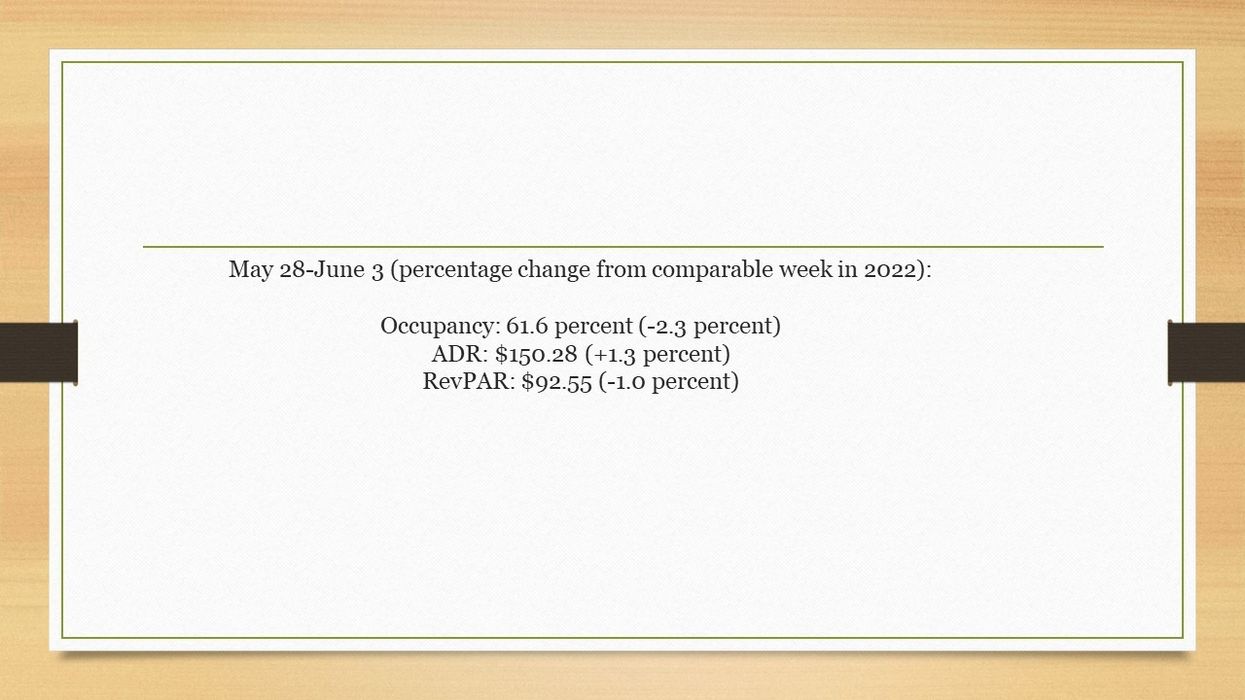
Occupancy reached 61.6 percent for the week ending June 3, down from 66.8 percent from the previous week and declined 2.3 percent compared to the corresponding week in 2022. ADR stood at $150.28 for the week, a dip from the previous week's $156.63 but still reflecting a 1.3 percent increase compared to the previous year. RevPAR amounted to $92.55 during the week, down from $104.62 the previous week and experiencing a 1 percent decrease compared to the same period in 2022.


Among the top 25 markets, Las Vegas reported the highest year-over-year increase in occupancy, with a climb of 9.5 percent, reaching 73.5 percent.

Washington, D.C., stood out in the holiday week with the only double-digit gain in ADR, increased 10.7 percent to reach $174.53. Boston registered the largest RevPAR increase, up 18.6 percent to $176.93 compared to the previous year.

The steepest RevPAR declines were seen in San Francisco, down 15.6 percent to $108.49 and Orlando, decreased 12.8 percent to $109.48.

More for you

Report: Rising Labor costs tighten US hotel industry margins
Photo credit: iStock

Report: Labor costs tighten U.S. hotel margins

Summary:

  • U.S. hotel margins tighten as demand slows and labor costs remain high, HotStats reported.
  • Unionized hotels carry 43 percent labor costs, versus 33.5 percent at non-union properties.
  • U.S. sees falling group demand and lower profit conversion since the second quarter.

THE U.S. HOTEL industry is showing signs of strain after a strong start to 2025, according to HotStats. Revenue growth is slowing, occupancy is falling and profit margins are tightening, particularly at unionized properties where labor constraints affect performance.

HotStats’ recent blog post revealed that TRevPAR has barely kept pace with labor costs in the first eight months of the year. While TRevPOR remains positive, gains are offset by declining occupancy, a sign that demand is cooling.

Keep ReadingShow less