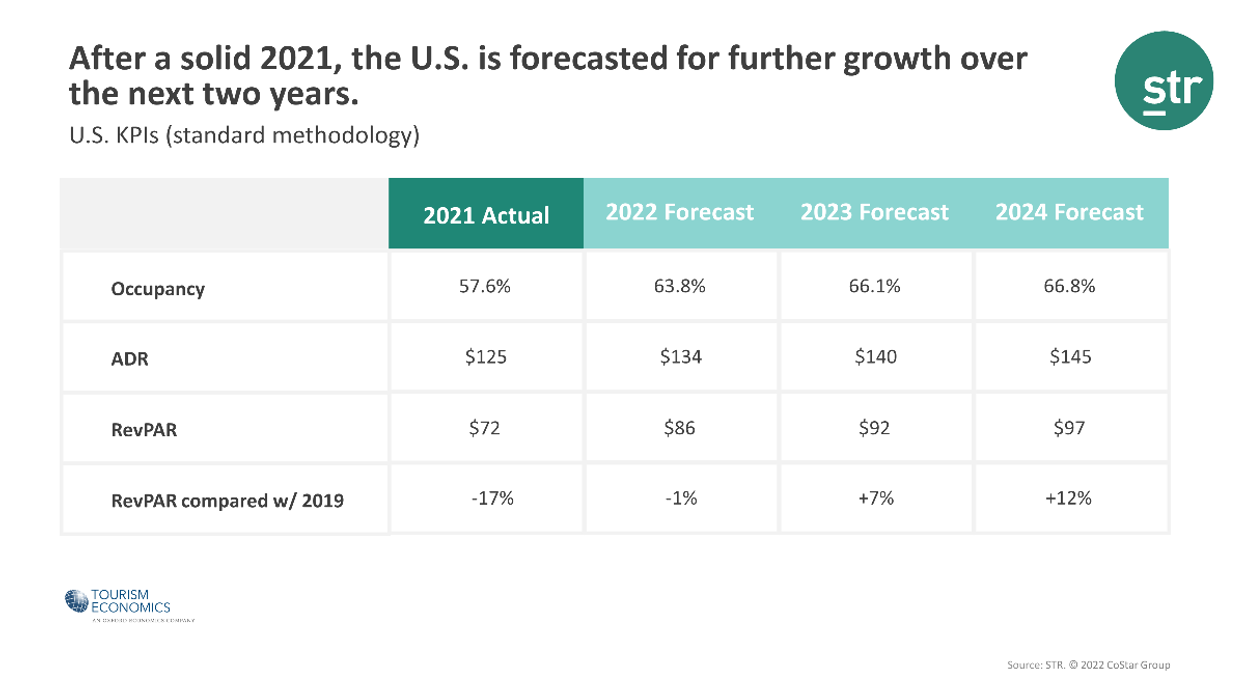

THE UPWARD MOVEMENT of ADR for U.S. hotels lifted the forecast for the market by STR and Tourism Economics. The travel research firms released the new forecast during the opening sessions of the Americas Lodging Investment Summit in Los Angeles on Monday.
The recovery timeline laid out in the new forecast remains mostly the same as the previous forecast released in November, with ADR will near full recovery this year. RevPAR is anticipated to exceed 2019 levels in 2023, but when adjusted for inflation ADR and RevPAR are not projected to reach full recovery until after 2025. Occupancy is projected to surpass 2019 levels in 2023.
“The industry recaptured 83 percent of pre-pandemic RevPAR levels in 2021, and momentum is expected to pick up after a slow start to this year,” said Carter Wilson, STR’s senior vice president of consulting. “With so much of that RevPAR recovery being led by leisure-driven ADR, however, it is important to keep an eye on the real versus the nominal. Terms of recovery are not playing out evenly across the board, and many hoteliers have had to raise rates to minimize the bottom-line hit from labor and supply shortages. We are anticipating inflation to remain higher throughout the first half of the year with a gradual leveling off during the third and fourth quarters. If that happens, and we avoid major setbacks with the pandemic, this year will certainly be one to watch with demand and occupancy also shaping up to hit significant levels during the second half.”
And so far it seems the recovery has legs, said Aran Ryan, TE’s director.
“Looking beyond the first quarter, the backdrop for sustained travel recovery is strong,” Ryan said. “As the public health situation improves, sturdy labor market fundamentals, healthy consumer balance sheets, and continued business investment are anticipated to support further lodging demand growth and pricing gains.”