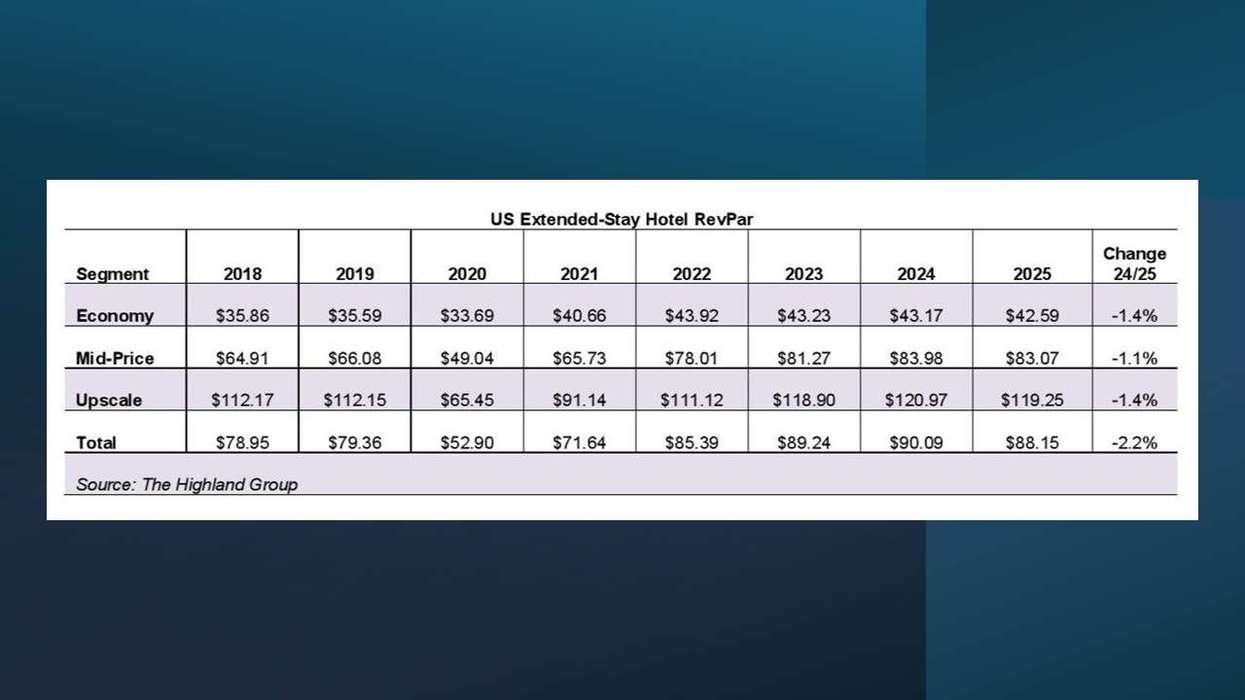

- Economy extended-stay hotels fell 1.4 percent in RevPAR in 2025.
- The segment’s demand rose 2.2 percent in 2025 compared to 2024.
- The hotel occupancy was 12.4 percent above the overall industry in 2025.
ECONOMY EXTENDED-STAY HOTELS reported a 1.4 percent RevPAR loss in 2025, slightly more than one third of the decline for all economy class hotels, according to The Highland Group. Midscale extended-stay hotel RevPAR fell 1.1 percent, less than half the decline for all midscale hotels.
The Highland Group’s “Report on the US Extended-Stay Hotel Market 2026” found a K-shaped pattern in 2025, with luxury hotels leading RevPAR growth and the economy segment recording the largest decline compared to 2024.
“Extended-stay hotel room supply growth accelerated in the latter half of 2025, but with new room construction and RevPAR both falling, supply growth should moderate and may decline in 2026,” said Mark Skinner, partner at The Highland Group.
Demand and occupancy
Extended-stay hotel demand increased 2.2 percent in 2025 compared to 2024, exceeding the 0.8 percent decline reported for the overall hotel industry. Adjusted for the 2024 leap year, demand rose every month, with the largest gains in the second half of the year. Supply exceeded demand from April onward and annual occupancy fell to its lowest level since 2020.
Total extended-stay hotel occupancy in 2025 was 12.4 percent higher than the overall hotel industry, excluding upper upscale and luxury segments and remained within the long-term occupancy premium over the last 25 years.
Revenues, ADR, RevPAR
Total extended-stay hotel room revenues reached a record in 2025, the report said. Excluding 2002, 2009 and 2020, the 1.8 percent revenue gain was the smallest since 1998. Monthly revenue growth was lower in the second half of 2025 than in the first six months, but the annual increase exceeded the 2.1 percent decline reported for comparable hotel classes by STR/CoStar.
Total extended-stay ADR declined each month after the first quarter of 2025, with the rate of decline increasing as the year progressed. Economy and midscale extended-stay segments posted ADR growth, while the upscale segment declined slightly. Segment changes in ADR reflected broader hotel industry trends. Total extended-stay ADR declined 0.4 percent, less than the 1 percent decline reported for comparable hotels by STR/CoStar.
RevPAR declined every month after the first quarter of 2025. Economy extended-stay hotels fell 1.4 percent for the year, less than the 3.9 percent decline for all economy hotels. midscale extended-stay hotels declined 1.1 percent, less than half the 2.4 percent drop for all mid-price hotels. Upscale extended-stay hotel RevPAR fell 1.4 percent, slightly above the 1.1 percent decline for all upscale hotels.
Total extended-stay RevPAR declined 2.2 percent, larger than individual segments, as economy extended-stay gained a greater share of room supply in 2025.
Supply dynamics
Extended-stay hotel supply grew 4 percent in 2025, the largest annual increase in four years. Economy extended-stay supply rose 8.7 percent, mainly from conversions in the first three quarters, while the mid-price segment led supply growth from September through year-end.
Rooms reported under construction decreased ten percent from last year and are at levels similar to two years ago. STR/CoStar estimates total hotel rooms under construction at 133,697, with nearly one third being extended-stay rooms. Economy and upscale segments recorded declines in rooms under construction, while the mid-price segment increased 17 percent.
Extended-stay hotel companies project a 3.4 percent compound annual increase in rooms through 2030. The lower projected supply growth compared to last year reflects uncertainty in near-term hotel RevPAR, interest rates and construction costs. Extended-stay rooms accounted for approximately 9.3 percent of total room nights at the end of 2019. Six years later, their share of total U.S. room supply increased to 10.9 percent.
The Highland Group’s “US Extended-Stay Hotels Bulletin: December 2025” found that extended-stay hotels showed signs of stabilizing in December, with RevPAR declining 2.1 percent, the smallest monthly drop since April. Occupancy for extended-stay hotels was 14.6 percentage points above the overall hotel industry.