
- AI is now a business imperative, not just a concept, according to Wyndham.
- Hotel owners turning to established brands for guidance, technology.
- Confidence in hospitality persists despite uncertainty.
ARTIFICIAL INTELLIGENCE MOVED from concept to business imperative, with hotel owners turning to established brands for guidance, technology and partnerships, according to a Wyndham Hotels & Resorts study. Additionally, confidence in hospitality’s long-term outlook persists despite rising costs, economic uncertainty and operational complexity.
Wyndham’s second annual “Owner Trends Report” found the industry at an AI inflection point: owners and developers are adopting AI but need guidance to convert early adoption into long-term returns.
"Artificial intelligence is rapidly reshaping hospitality—opening new opportunities while adding fresh layers of complexity,” said Scott Strickland, Wyndham’s chief commercial officer.
Nearly all hotel owners, 98 percent, have begun using AI, indicating widespread adoption in hospitality. However, execution is uneven: fewer than one-third, 32 percent, say AI is embedded across most operations and nearly three-quarters, 73 percent, want to do more but are unsure where to start.
The findings were based on a survey of hundreds of hotel owners and developers across the U.S., Canada, and the Caribbean, representing multiple brands and hotel companies beyond Wyndham.
Among owners and developers using AI, common applications include operational efficiency at 64 percent, energy efficiency at 54 percent and revenue optimization at 53 percent, all with direct impact on profitability, the report said. For 2026, 61 percent of hoteliers want AI to play a larger role in construction planning, such as permitting and zoning, followed by revenue optimization at 30 percent.
As AI adoption increases and operations grow more complex, owners and developers turn to brands to help vet, integrate and support technology solutions, the study found. Nearly nine in ten hoteliers, 89 percent, say working with a hotel brand is beneficial for AI adoption, with more than one-third, 34 percent, calling it essential.
However, top barriers to further AI adoption include data privacy and security concerns at 46 percent, investment costs at 42 percent and integration with legacy systems at 40 percent, Wyndham said. Views differ on AI-led decision-making. Two in five, 40 percent, are comfortable with AI making operating decisions without human oversight, while 57 percent require oversight.
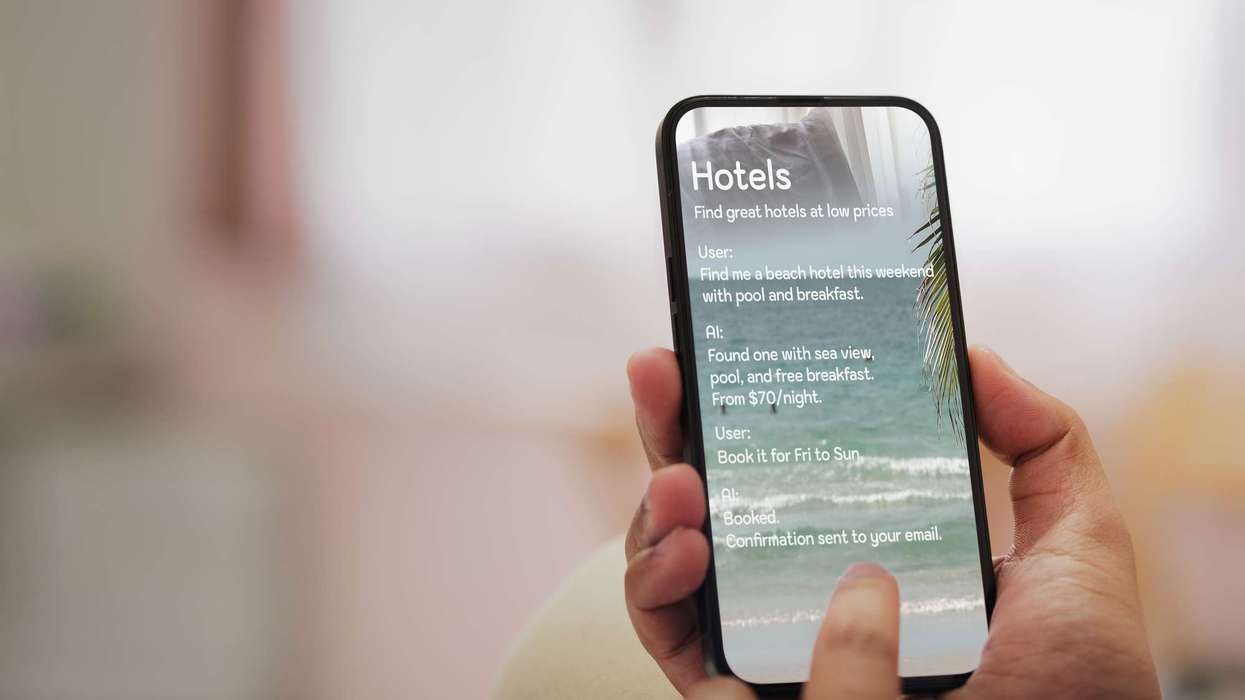
A separate study by TakeUp found that about 90 percent of U.S. travelers use AI tools to plan or book travel, comparing prices, evaluating accommodations and making booking decisions.
Future beckons
Despite economic pressures, hoteliers enter 2026 with confidence in the industry’s outlook, consistent with findings from Wyndham’s first Owner Trends Report. Around 90 percent are optimistic about 2026 and 95 percent about the next five years.
Amit Sripathi, Wyndham’s chief development officer, said this year’s report shows once again the overwhelming confidence hoteliers have in the long-term resiliency and proven ROI of our industry.
“The results also underscore improving market conditions, with 61 percent of hoteliers seeing easier financing and a near even split when it comes to interest in new construction versus conversion opportunities,” he said.
Nearly eight in 10 hoteliers, 79 percent, plan to expand their portfolios over the next five years, in line with last year’s report. About 97 percent say they are open to joining or switching brands if the right opportunity arises. About two-thirds of hoteliers, 65 percent, say a strong loyalty program is important to their success. Top obstacles include operating costs, talent shortages and competition.
For 2026, 24 percent of hoteliers plan to prioritize staffing, followed by property improvements at 20 percent, sales and marketing at 20 percent, technology at 19 percent and amenities at 17 percent, indicating owners continue to balance service and guest experience with operations and marketing.