
HOTEL STOCK PRICE volatility dragged the Baird/STR Hotel Stock Index in November. Both the hotel brands and hotel REITs significantly underperformed their respective benchmarks during the month.
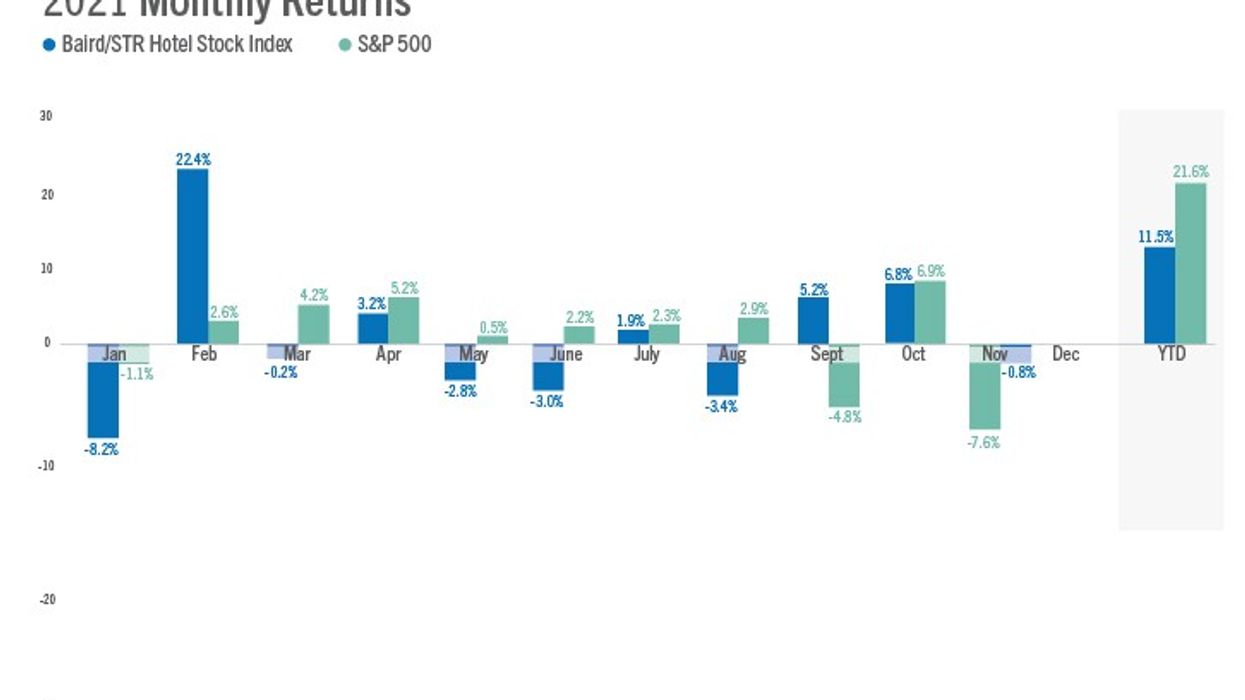
The Baird/STR index fell 7.6 percent during the month from October. However, it was up 11.5 percent year to date through the first 11 months of 2021. The index rose 6.8 percent during October compared to September.
The index was behind both the S&P 500, which fell 0.8 percent in November, and the MSCI US REIT Index, which dropped 0.9 percent. The hotel brand sub-index dropped 7.2 percent from October while the hotel REIT sub-index slipped 8.9 percent.
“Hotel stock price volatility continued in November with both the Hotel brands and Hotel REITs significantly underperforming their respective benchmarks,” said Michael Bellisario, senior hotel research analyst and director at Baird. “Two different investment narratives drove stock price performance during the month: In early November, third quarter earnings were better than expected, reopening optimism continued to gain momentum, and the hotel brands were hitting new all-time highs; but, by the end of the month, broader growth and inflation concerns surfaced, the Omicron variant spooked investors and impacted all travel-related stocks, and the hotel REITs were hitting new year-to-date lows.”
The best Thanksgiving week performance on record reinforced the notion that U.S. travelers are buoyant about leisure trips while business travel, especially to attend group meetings, is still subdued,” said Amanda Hite, STR president.
“Our new forecast with Tourism Economics projects that the industry will near 2019 levels of demand and room rates in 2022 with the overall recovery timeline moved up one year. We are of course monitoring for any potential impact from the Omicron variant, but if history is a guide, the impact will be most pronounced in international travel figures with much smaller effects on domestic travel patterns. Regardless, pressure on margins will continue to weigh on operators’ minds as increases in ADR may not be enough to make up for the higher wages across all chain scales," she said.